From Protection to Trust: A New Approach to Mosque Security
The safety and security of British Muslims has become one of the most pressing public policy challenges facing the country. Across Britain,...
Read more

Author: Prof. Francis Davis
Published on: July 24, 2026
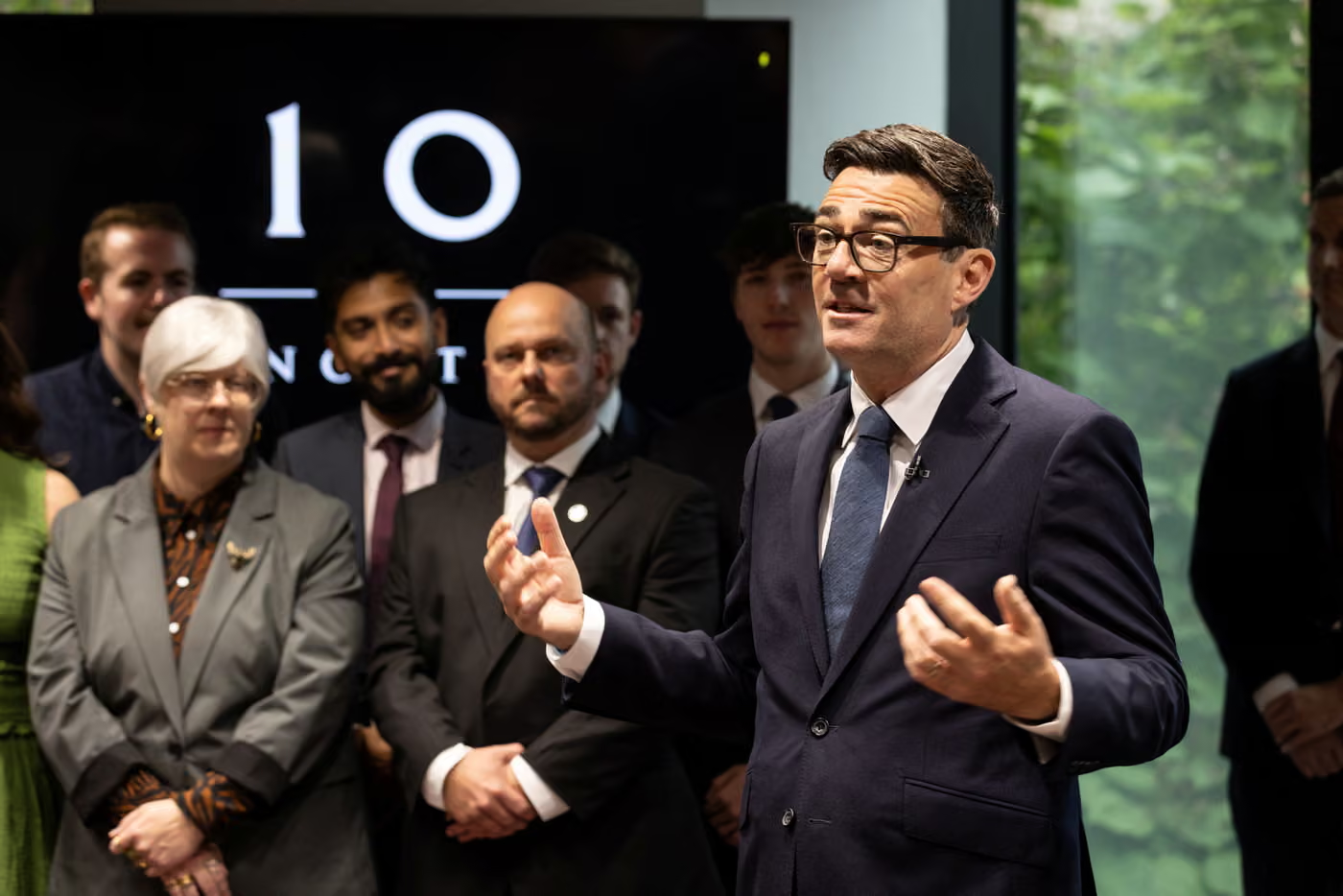
When Andy Burnham became the UK’s new Prime Minister, it was the first time for a Roman Catholic to assume this role. How has Andy Burnham’s Catholic identity shaped his work in politics, and what may this mean for the country under his leadership?
Andy Burnham’s Catholicism is rooted in the distinctive history of the Lancashire communities where he has spent his life. During the centuries when Catholicism was restricted in England, this area produced many of the men later remembered as the Lancashire Catholic Martyrs. Their legacy remains visible in local churches, schools and public landmarks, including St Edmund Arrowsmith Catholic High School, where Burnham’s children were educated.
Over time, this tradition merged with large Irish migrant communities who worked in the local mines and helped build strong networks of mutual support. Catholic institutions became important providers of welfare and social care, with organisations such as Nugent Care emerging from this tradition. Burnham’s own family life was shaped by these close-knit working-class communities, including his Irish mother and a culture that combined faith, solidarity, family commitment and trade union values.
Being an altar boy was therefore about more than worship. It meant belonging to a wider associational life of sports clubs, social activities, youth groups and community events. Burnham’s experience of Catholicism was shaped less by theological conservatism than by a practical ethos of service, inclusion and collective responsibility.
This outlook was reinforced by figures such as Archbishop Derek Worlock, who challenged the social consequences of Thatcher-era reforms, and by Burnham’s mentor, the Catholic Labour MP Paul Goggins. Through these influences, Catholic social teaching became linked to anti-poverty work, social justice and the belief that politics should improve the lives of those most in need. It was this social idealism that drew Burnham towards the Labour Party.
Burnham has often said that three institutions shaped him: Everton Football Club, the Labour Party and the Catholic Church. Together they fostered a worldview grounded in place, belonging and mutual aid. It is an outlook formed far from Westminster and rooted instead in communities where strong families, civic associations and local solidarity offered protection from hardship.
The wider lessons for what might be possible under a Burnham premiership are significant. In a country where some communities are too often viewed with suspicion, his emphasis on solidarity offers the prospect of a more inclusive national story. Equally, at a time when faith leaders have often been hesitant about devolution, there is an opportunity to rediscover the civic potential of local communities.
As decentralisation deepens, mayors could become more important convenors of community cohesion and civic partnership. Burnham’s Faith and Belief Advisory Panel in Greater Manchester provides one example. Another was the large interfaith summit convened by Mayor Andy Street in the West Midlands, which I chaired in 2017, bringing together faith and civic leaders around jobs, crime and skills. In the United States, President Biden’s Enhancing Sub-National Diplomacy Act similarly recognised the value of local and diaspora networks in promoting investment and international engagement. On the other hand, a stronger emphasis on British life beyond ‘that there Westminster’, in coastal communities and on civic partnerships, creates new spaces in which those shut out by his predecessors’ often excessively metropolitan cadres can now enter in to refresh policy more widely.
A stronger focus on life beyond Westminster also creates space for voices and communities that have often been overlooked. The appointments of Stephen Timms MP and Satvir Kaur MP to ministerial roles with equalities responsibilities, working alongside Angela Rayner at MHCLG, point towards new opportunities. Bridget Phillipson, another Catholic, is well placed to help embed an agenda of inclusivity and participation across Whitehall, while ministers such as Douglas Alexander and Shabana Mahmood will be important partners. As policy is improved, new ideas and fresh allies need to enter in, and Equi’s recent reports on health, education, Islamic finance, youth violence among others have lessons for every ministry in numerous regards.
Ultimately, a ‘Makerfield Test’ raises the bar though. It reminds us that we are now not only working on an equalities project or a ‘community’ problem but that England and Britain more generally – from Bickershaw to Millbrook, Thanet to Byker, Lincoln to Wythenshaw, Erdington, Efford, Pontefract, Sparkbrook, East Ham and Clacton – is made up of multiple histories, huge talents and rich communities. The country is full of amazing people bursting to belong, happy to contribute and ready to build a common life if only those who, patronisingly, find it ‘hard to reach’ the neighbourhoods in which they live could get out of their ivory towers and get to know them. It is a test that challenges Equi’s friends and all other people of goodwill to lean in to share in the coming task of social renewal too.
Francis Davis is an Equi Fellow, a Visiting Fellow at Kellogg College, University of Oxford and Honorary Professor at Queen Mary, University of London. He is a former member of the Portsmouth Anglican Diocese Council for Social Responsibility and a current governor of the Chaldean Catholic University of Erbil in Iraq. In 2025 the UK Muslim Community Association gave him a national award for educational empowerment of Muslims by a non-Muslim.
The views expressed in Equi Comments pieces reflect the author’s perspective and do not necessarily represent the views of Equi. We provide this platform to encourage dialogue on broad themes related to our work, from diverse perspectives.
Stay updated on relevant topics, expert opinions, and the latest trends in the industry.